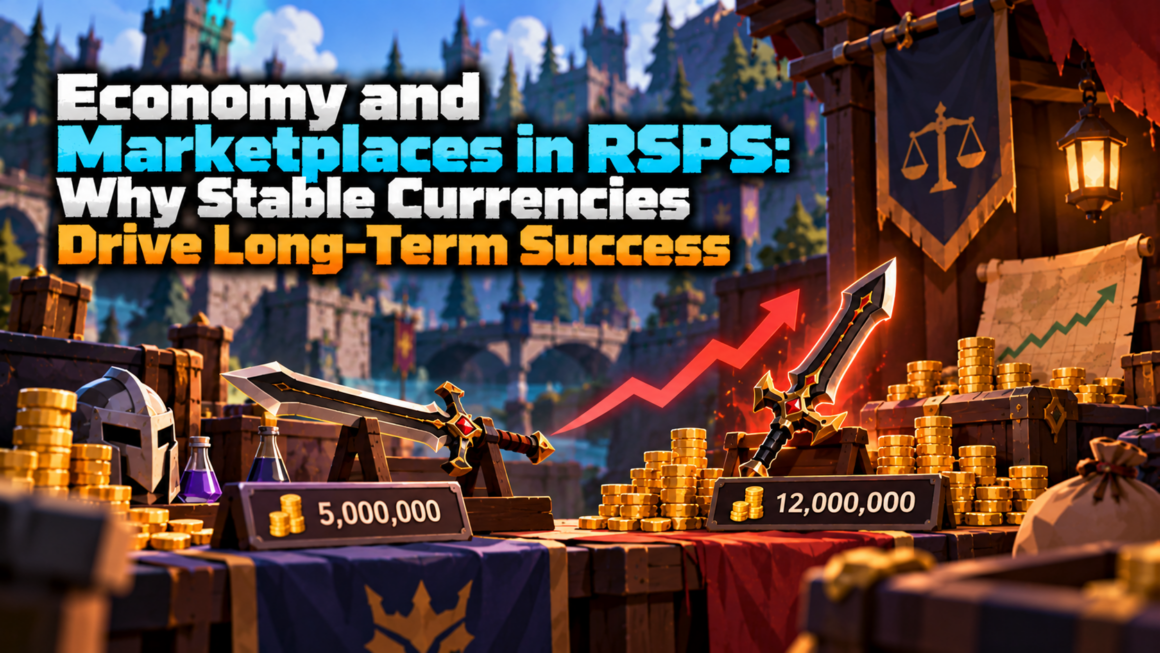
You sell a rare sword for 5 million coins. Nice. A week later, the same sword costs 12 million. Did it get better? Nope. There may just be too much gold on the server.
That’s a bad sign. In a good RSPS economy, your time has value. You can save for an item, sell a drop, and know more or less what your coins can buy. When prices go wild, even a huge bank can feel poor.
A Million Coins Should Still Mean Something
Gold is useful because players trust it. They know they can trade it for food, gear, or other items later. Once that trust goes, trading gets weird. One player asks 20 million for a weapon. Another wants three rare items instead of coins. Nobody knows the right price.
A price rise is not always bad. A rare sword may cost more when many players want it. That is normal. The real problem starts when almost everything costs more because coins are too easy to get.
Where Does All That Gold Come From?
Not every sale adds money to the game. If I pay you 100,000 coins for a shield, the same 100,000 coins simply move from my account to yours. No new gold appears.
New coins enter when the game gives them out. Here are common sources:
- Monster drops. A boss or monster drops coins after a kill.
- NPC shops. A player sells items to a game-run shop for coins.
- Game rewards. Tasks or events pay coins directly.
- Item conversion. A spell or system turns an item into coins, if the server allows it.
Here’s a simple example. Say 100 players each earn 20,000 new coins from NPCs in one day. That puts 2 million new coins into the world. Player trades then move those coins around; they do not create another 2 million.
The difference matters. A marketplace can be busy while the total amount of gold stays the same.
A Market Needs Buyers, Not Just Full Shops
You can browse RuneScape private servers on MoparScape and find worlds that focus on trading and long-term play. But a server saying “great economy” tells you little on its own. Some worlds use a trading post. Others have player-run shops or direct trades.
These tools make trading easier, but they cannot make someone want your item. If 40 players list dragon boots and nobody needs them, the market is stuck.
A Trading Post Is Not a Price Machine
A listed price is what a seller wants. A completed sale shows what a buyer paid. Big difference, bro.
Say you see a staff listed at 8 million. That does not prove it’s worth 8 million. If similar staffs sold for 5 million yesterday, the seller may simply be asking too much. Recent trades help more than big numbers on the screen.
|
What You See |
What It May Mean |
What to Look At Next |
|
Many items listed, few sales |
Lots of sellers, not enough buyers |
Recent completed trades |
|
One player owns most of an item |
They may be able to push up the price |
Other sellers and new item drops |
|
Food sells every day |
Players use it and need more |
Supply and sale speed |
|
Gear prices jump after an update |
A new rule may have changed demand |
Patch notes and actual sales |
A rare pet or weapon may bring a big sale once. Food, runes, and potions can bring smaller sales every day. These items get used up. Players must buy or make more.
Rare gear gives people big goals. Everyday goods let new players earn coins without a lucky boss drop.
Free Rewards Are Fun Until Everyone Has the Same Item
A welcome gift feels great. But imagine a new RSPS giving every account ten strong swords. Soon, those swords are everywhere. Why would anyone buy one from a boss hunter?
This is one place where a promo and a game economy are very different. A player looking up a CSGOPolygon promo code may care about a sign-up offer. On a private server, a free item can change prices for everyone, even people who never claim it.
Not All Free Items Cause the Same Trouble
A short boost may end after an hour. A free sword can stay in the game for months. And 500 free swords have a much bigger effect than 500 loaves of food that players eat that day.
Think about what happens to the gift:
- Food gets used. Players need more after each trip.
- Gear stays. It may be sold again and again.
- Tradeable gifts spread. One account can pass rewards to another.
- Coins add buying power. Players can offer more money for the same rare drops.
A fair event can still give good rewards. Small supply packs, cosmetic items, or items that cannot be traded may put less pressure on the market. What matters is how many rewards enter the game and how long they stay there.
Gold Sinks: Where the Coins Go
If the game keeps making coins and never takes any away, the total can grow fast. That is why many games use a gold sink. It is simply a way to remove coins from the game.
Not every payment is a gold sink. When you pay another player, the gold still exists. When you pay a fee to the game and those coins are deleted, they are gone.
How a Trading Tax Works
Imagine you sell an item for 5 million coins. The marketplace takes a 2% fee and removes it from the game.
- Buyer pays: 5,000,000 coins
- Seller gets: 4,900,000 coins
- Gold removed: 100,000 coins
That is just an example for an RSPS, not a tax used by every private server. Official Old School RuneScape also uses a Grand Exchange tax, but each private world sets its own rules.
Other possible gold sinks include fees for a house upgrade, an item repair, or a paid game service. They only remove gold if the coins do not go to another player.
Too Much Tax Can Hurt, Too
Big fees can stop players from trading cheap items. If selling ten potions costs more than the profit, why bother?
Good systems take money out while letting small trades stay useful. They also make fees easy to see before a player clicks Sell.
Item Sinks Solve a Different Problem
Gold sinks remove coins. Item sinks remove items. You need to know the difference.
Let’s say a boss drops 20 copies of the same rare sword each day. Players only want ten more. After a while, extra swords pile up. The price may fall even if the amount of gold does not change.
An item sink gives extra items a way to leave. The server might use a sword in an upgrade system, delete one when making a stronger item, or remove selected gear through a special trade system. It depends on that world’s rules.
|
Problem |
What Builds Up |
One Possible Fix |
|
Prices rise across many goods |
Too much gold |
Fees that remove coins |
|
One boss drop becomes very cheap |
Too many copies of that item |
An upgrade that uses up the item |
|
Shop supplies never sell |
Easy, unlimited NPC stock |
Change the shop stock or price |
|
No one can find basic materials |
Too few sellers or useful sources |
More ways to gather and trade them |
A gold sink won’t fix an endless supply of swords. And deleting swords won’t remove extra coins. Fix the right problem.
NPC Shops Can Quietly Kill Player Trade
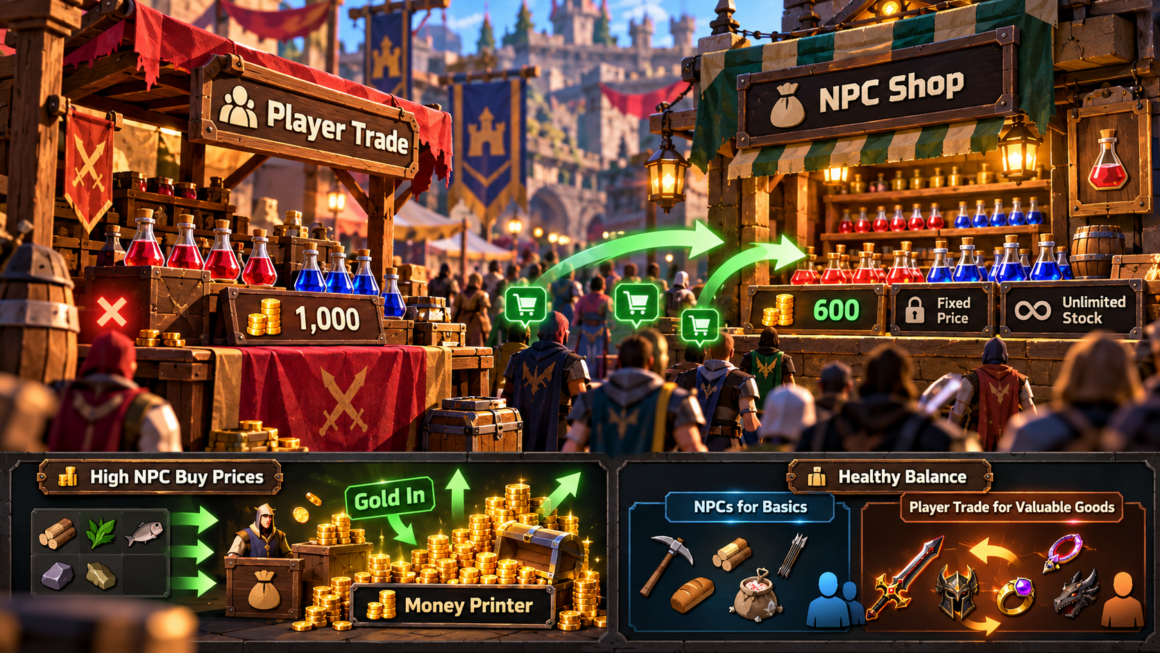
Picture this. You spend an hour making 200 potions. You hope to sell each one for 1,000 coins. Then you learn that an NPC sells the same potion for 600 coins with no stock limit.
Who will buy yours? Almost nobody.
NPC shops are useful for tools and basic supplies. But their prices and stock levels affect every player trying to sell the same goods.
Fixed Prices Create a Limit
If an NPC always sells an item for 600 coins, buyers usually have no reason to pay another player 1,000. The shop puts a limit on what people may pay, unless travel, stock, or other rules make buying from the NPC harder.
The other side matters too. If an NPC buys a common drop for 5,000 coins with no limit, farming that drop can put large amounts of new gold into the game. A simple shop can become a money printer.
Good shop design is often quiet. Tools are easy to find, common items have fair prices, and players still have a reason to trade with each other.
What If a Server Has Two Kinds of Money?
Some RSPS worlds have more than gold. You might see event points, boss tokens, or a special shop coin. That can be fine, as long as people know what each one buys.
Can You Trade the Extra Currency?
Say one rare sword costs 10 million gold in a player shop. Another player asks for 200 tokens. You need to know if those tokens can be traded and how hard they are to earn. If the tokens cannot move between players, that second price is not a normal player trade.
Too many kinds of money can make prices hard to read. Gold works best when it still pays for normal items. Extra points work better when they have a simple use and clear rules.
Why a New RSPS Feels Rich at First
At launch, nobody has much gear. A basic weapon can be valuable. Even logs and ore may sell well because everyone needs them at once.
A few weeks later, the same server can look very different. Some players have full banks. Others have stopped playing. A strong boss drop may no longer be rare.
The First Month Changes Prices Fast
Here’s an example, not a real server’s price history:
|
Time |
Typical Market Change |
|
Launch day |
Tools, food, and starter gear are in high demand |
|
Week one |
More players reach mid-level bosses and sell drops |
|
Week two |
Common gear gets cheaper as more copies appear |
|
Month one |
Rare gear, daily supplies, and long-term upgrades become the main trades |
This isn’t a set rule. A big update, more players, or an item change can move prices in a new direction overnight.
A reset can give everyone a fresh start, but it also removes the market history players have built. If a server resets often with no clear plan, some people may stop saving for large goals. Why build a big bank if it will soon disappear?
Seasonal worlds can work when players know the end date and want a fresh race. A long-term economy needs different expectations.
Rich Players Are Not Always the Problem
It’s easy to blame one player with 10 billion coins. But coins sitting unused in a bank do not raise prices by themselves. Prices move when players start offering more money for the same goods.
A wealthy player can still change a small market. If only five rare rings are for sale and one person buys them all, the next seller may ask much more. Other players can wait or farm more rings.
What About Bots and Item Dupes?
A bot may farm a common resource all day. That can push its price down by adding too many copies. A bot that farms raw coins can add too much money instead. The effect depends on what it produces.
An item dupe is worse. It copies items that were not earned through normal play. A sudden wave of rare gear can hurt the value of drops people worked hard to get. Fast fixes and removing copied items matter because one exploit can affect the whole market.
How a Healthy Economy Helps Small Players
You join with almost no coins. So how do you earn your first million? On a useful market, you don’t need a lucky rare drop. You can sell food, runes, simple supplies, or items that busy players do not want to gather themselves.
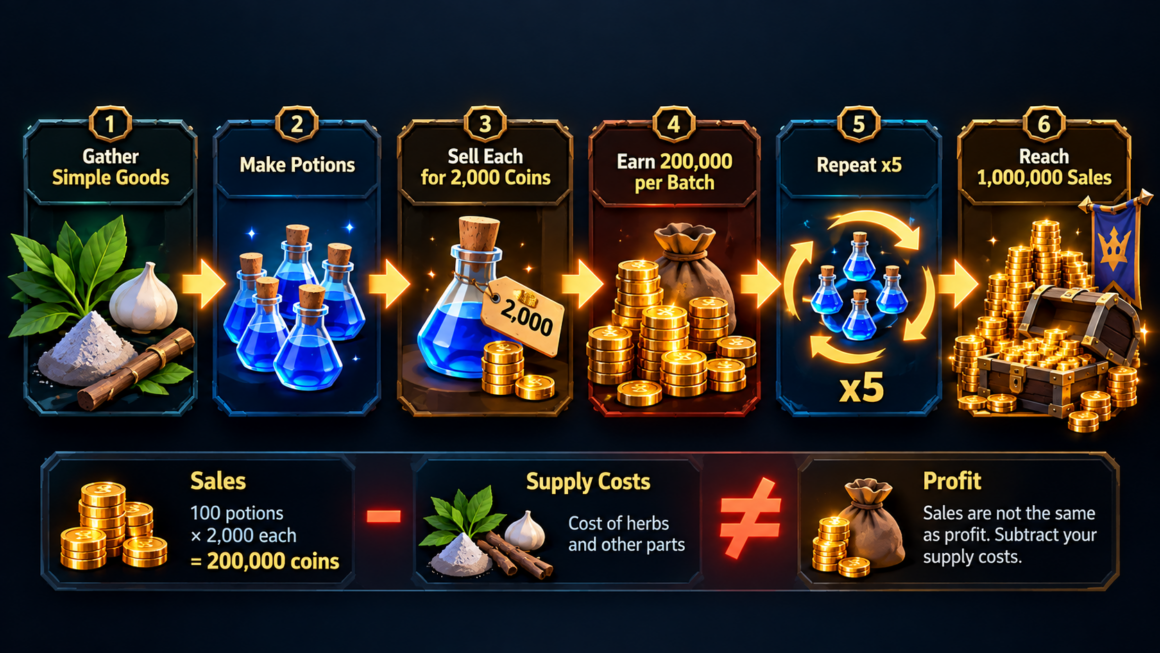
Let’s say you make 100 potions. You sell each for 2,000 coins, so you get 200,000 coins before any fees. Do that five times and you have made 1 million in sales. Your real profit will be lower if you paid for the herbs or other parts.
That last point matters since sales are not the same as profit. Players who buy all their supplies need to count those costs.
A market with small trades gives new players a place to start.
A Good Economy Gives You a Reason to Log In Tomorrow
The best part of a stable RSPS economy is simple. Your work today helps your next goal. You know why your food sells. You can save for a weapon. When you finally get a rare drop, another player may actually want it.
Servers don’t need fixed prices or free gold to make that happen. They need useful items, real trade, and rules that stop coins or gear from flooding the world.
A big bank looks cool. A bank that can still buy something next month is much better.