
After paying multiple cryptocurrency tracing companies without recovering her money, one fraud victim discovered an unexpected path to financial relief through Lionsgate Intelligence Network and the U.S. tax system.
She thought her money was gone forever.
After falling victim to scammers she met online, she faced the same devastating reality experienced by thousands of Americans: her savings had disappeared, the criminals were out of reach, and conventional recovery options offered little hope.
She had even hired several cryptocurrency tracing companies. They managed to trace the stolen funds, but that was where their assistance ended. Knowing where the money had gone offered little comfort when all she wanted was to get it back.
But her story took an unexpected turn.
After watching a television interview with the CEO of Lionsgate Intelligence Network, she decided to contact the company.
Through Lionsgate’s tax-loss substantiation process, her documented fraud losses helped her obtain more than $250,000 in tax relief.
The money did not come from the scammers.
It came through the U.S. tax system.
According to Lionsgate, this alternative path to financial relief could be relevant to many Americans who have lost money to cryptocurrency scams, fraudulent investment platforms, and other investment-related financial crimes.
“Victims don’t come to us because they want another tracing report. They come because they want their money back,” says Bezalel “Eithan” Raviv, Founder and CEO of Lionsgate Intelligence Network. “Our job is to find a real financial outcome. If the money can be recovered, we pursue that path. If it cannot, we investigate whether the loss can be documented for tax relief. Either way, victims deserve more than a report telling them where their money disappeared.”
The Recovery Option Most Scam Victims Have Never Heard About
When someone loses money to an investment scam, the natural question is: How do I get my money back?
Most victims contact their bank, report the crime to the FBI, or search for a cryptocurrency recovery company.
But there is another question that often goes unanswered:
What if the money cannot be recovered, but the financial loss could qualify for tax relief?
Under Section 165 of the Internal Revenue Code, certain theft losses incurred in transactions entered into for profit may qualify for a federal income-tax deduction.
For eligible taxpayers, the financial benefit can be substantial.
The challenge is proving the loss, establishing the relevant facts, and documenting whether there is a reasonable prospect of recovering the stolen assets.
That is where Lionsgate Intelligence Network comes in.
How Lionsgate Turned a Fraud Investigation Into a Tax Recovery Opportunity
Lionsgate Intelligence Network specializes in financial intelligence, blockchain forensics, and evidence-based fraud investigations.
Founded by Bezalel “Eithan” Raviv, the company helps victims understand where their stolen funds went and what legal and financial options may still be available.
Its approach begins with an investigation, not a promise.
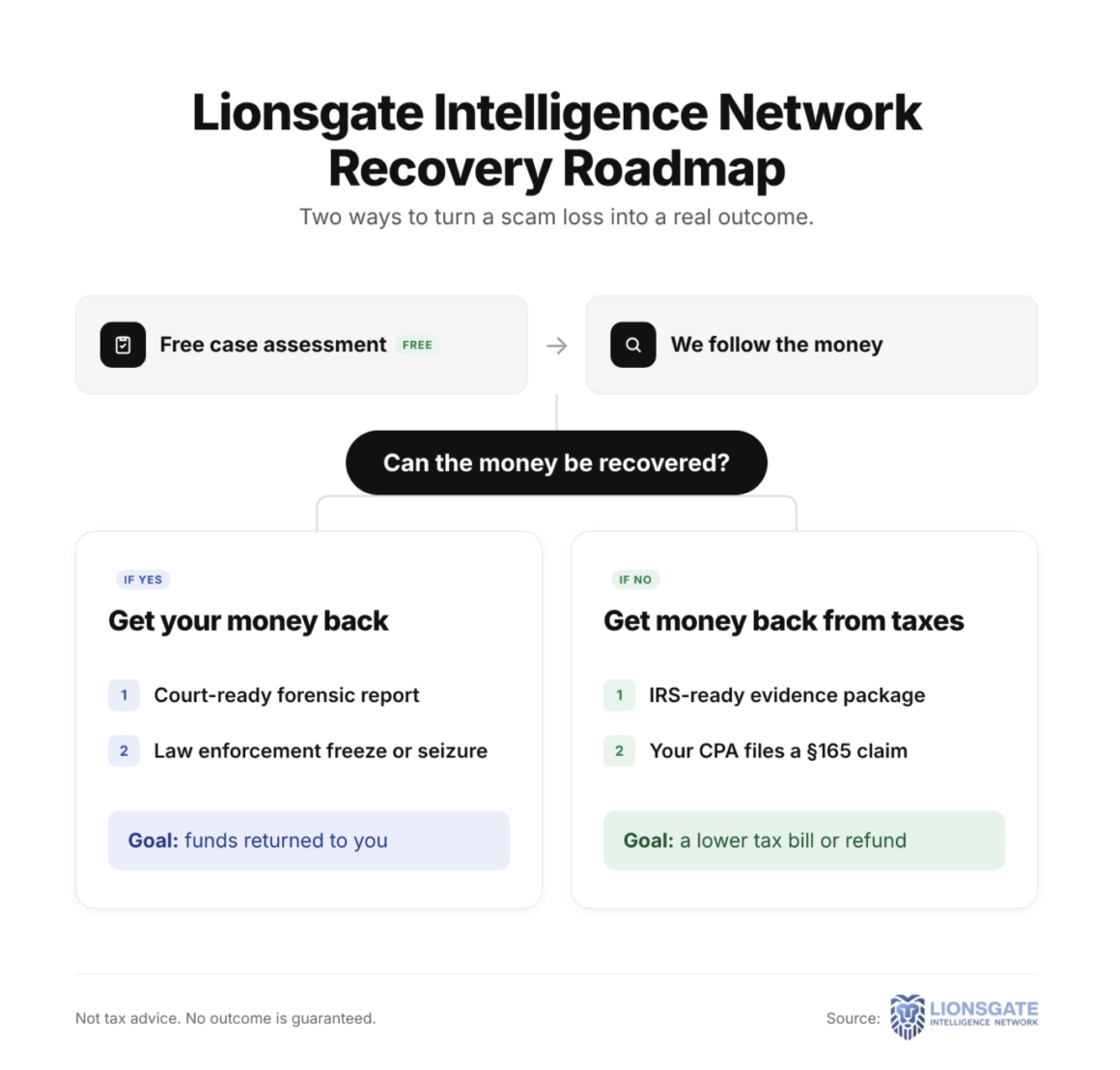
The process involves five steps.
Step 1: A Free Assessment of the Fraud
Victims submit information about their losses, including bank transfers, cryptocurrency transactions, investment platform records, and communications with suspected scammers.
Lionsgate reviews the available evidence and assesses whether the stolen assets may be recoverable.
Step 2: Tracing the Stolen Money
Investigators reconstruct the movement of funds using blockchain analysis and financial intelligence, where applicable.
The goal is to determine whether there are realistic opportunities to identify, freeze, or recover stolen assets.
Step 3: Determining Whether Tax Relief May Be an Option
If the investigation indicates that recovery is no longer reasonably expected, Lionsgate examines whether the documented facts may support a theft-loss claim.
The assessment of recoverability must be supported by evidence and evaluated under the applicable tax rules.
Step 4: Preparing an IRS-Ready Evidence Package
Lionsgate prepares forensic documentation designed for review by a CPA or tax attorney.
The package may include proof of ownership, transaction histories, the actual amount invested, evidence of theft, and a documented assessment of recovery prospects and potential crypto scam tax deduction.
Step 5: The Tax Professional Evaluates and Files the Claim
A qualified tax professional determines whether the taxpayer qualifies for a deduction, the appropriate tax year, and the amount that may be claimed.
If the claim results in a reduction in tax liability or a refund, the victim may receive meaningful financial relief without recovering the stolen cryptocurrency itself.
Why This Matters for Millions of Americans
Financial scams are no longer limited to cryptocurrency.
Fraudsters use fake trading platforms, fraudulent brokerage accounts, online relationships, wire transfers, and sophisticated impersonation schemes to steal money.
Many victims assume that once law enforcement cannot recover their funds, the case is closed.
But the financial investigation may still have value.
Evidence that cannot lead to asset recovery may nevertheless help establish the facts needed for a legitimate tax-loss claim.
For some victims, this can mean a significant reduction in the financial damage caused by fraud.
Why Lionsgate Intelligence Network Is Different
Most cryptocurrency tracing services focus on identifying where stolen funds have traveled.
Lionsgate takes the process further by connecting forensic investigations with two potential financial outcomes.
Path One: Asset Recovery
When the evidence supports a credible recovery opportunity, Lionsgate helps prepare the case for appropriate investigative and law enforcement action.
Importantly, Lionsgate only accepts cases for its asset recovery program when its initial assessment identifies a credible basis for pursuing recovery.
This selective approach is designed to prevent victims from paying for recovery services when the available evidence does not support a realistic recovery strategy.
Path Two: Tax-Loss Substantiation
When recovery is no longer reasonably expected, Lionsgate helps prepare documentation that a tax professional can use to assess potential relief under Section 165.
This gives eligible victims another option to explore rather than ending the process when direct recovery appears unlikely.
The difference is simple: Lionsgate doesn’t stop at tracing stolen money. It investigates what can actually be done with the evidence.
Who May Qualify?
The program is designed for Americans who have suffered qualifying investment-related theft losses, including certain cryptocurrency investment scams and fraudulent trading schemes.
Eligibility is not automatic.
A qualified tax professional must evaluate whether the facts establish theft under applicable law, whether the transaction was entered into for profit, the amount of the actual loss, and whether there was a reasonable prospect of recovery at the relevant time.
Personal-use losses, unrealized platform profits, and other amounts may be subject to different treatment or may not qualify.
The New Meaning of Financial Recovery
For the woman who obtained more than $250,000 in tax relief, the outcome illustrates an important distinction.
The criminals did not return her money.
Instead, her documented financial loss opened a different path to financial relief.
That is the opportunity Lionsgate Intelligence Network wants more victims to understand.
Even when stolen money cannot be recovered, a properly documented investigation may still provide a way forward.
Were you scammed by a fraudulent investment platform, cryptocurrency scheme, or online investment fraud?
Lionsgate Intelligence Network offers a free initial assessment to help determine whether asset recovery or tax-loss substantiation may be appropriate.
Find Out Whether Your Loss May Qualify
Lionsgate provides forensic intelligence and factual documentation, not tax advice. Tax deductions and refunds are subject to applicable law and individual circumstances. No financial outcome is guaranteed.