You can find hundreds of casino games online. Each game has its own style and design. There are multiple versions of the same game. Some games also appear in multiple variants. As you play, you may wonder who created all of these variations. Casino operators run the sites, process payments and manage player accounts. So, who develops and creates all of these games?
They are created by independent game studios. A game studio creates games and licenses the games to online casinos. Game studios are responsible for the graphics, sound effects, storyline, and other aspects of games. While some game studios are located all around the world, a large number of game studios are based in Europe.
A serious online casino sources games from many different game studios to compete for players’ limited attention. Online slots sit alongside blackjack, baccarat, and a range of live dealer games. Online casino games require continuous improvement to compete. The same competition is apparent at Don.ro Online Casino.
The Game Developers
Most game development studios opt to license their games rather than sell them. With this model, the game development studio retains ownership of its product. This includes the code that powers the game, the certifications required to distribute it, and the rules and equations that dictate the game’s mechanics and behavior. The game development studio charges a royalty to casino game operators for each use of the game.
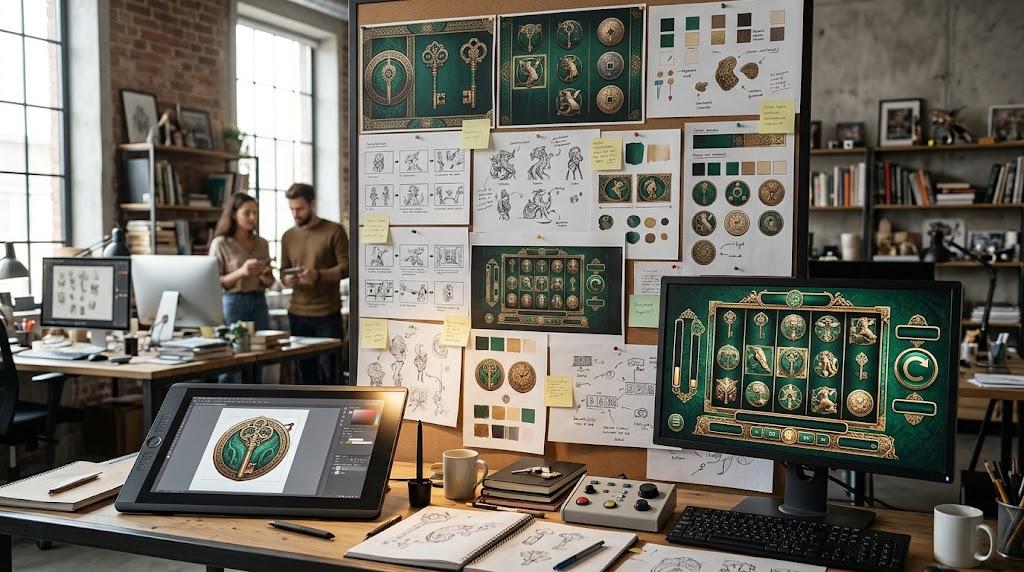
The studio employs a diverse group of creatives that include designers, artists, mathematicians, sound designers, and programmers. Designers help create the player journey, determining how players move through a game and what rewards are offered along the way. Artists give game elements a visual representation. Sound designers and composers build atmosphere through music and sound effects. Programmers bring designers’ ideas and artists’ representations to life by creating game software. A quality assurance team tests the game to break it before it is released.
A team usually comprising eight to fifteen employees works together for several months to produce a game that is thematically integrated and easy to use. The game is developed before anyone outside the studio sees it.
A New Slot Game: The First Step is Math
Initially, the studio focuses on the math elements of a game. The math model defines the return-to-player percentage, volatility, hit frequency, and the structure of bonus features. Once the design is agreed upon, the frame and structure of the game are determined. Programming teams work within the framework determined by the design team. Once a game element is programmed, changing the math design is very difficult and costly.
Modern slots’ RTPs are usually between 94% and 97%. RTP isn’t the only factor that determines a slot’s design. Volatility is equally as important. Volatility affects the frequency and size of wins. Slots with high volatility offer less frequent payouts with higher amounts, while the opposite is true for low volatility slots. The design of the slot, specifically the math model, largely determines a player’s experience.
Once the math model has been finalized, the design and art of the slot are created. Artists design backgrounds and other game assets. Sound effects and music must also be created to supplement the game’s theme. The programmers integrate all elements and resources to create a stable and functional game.
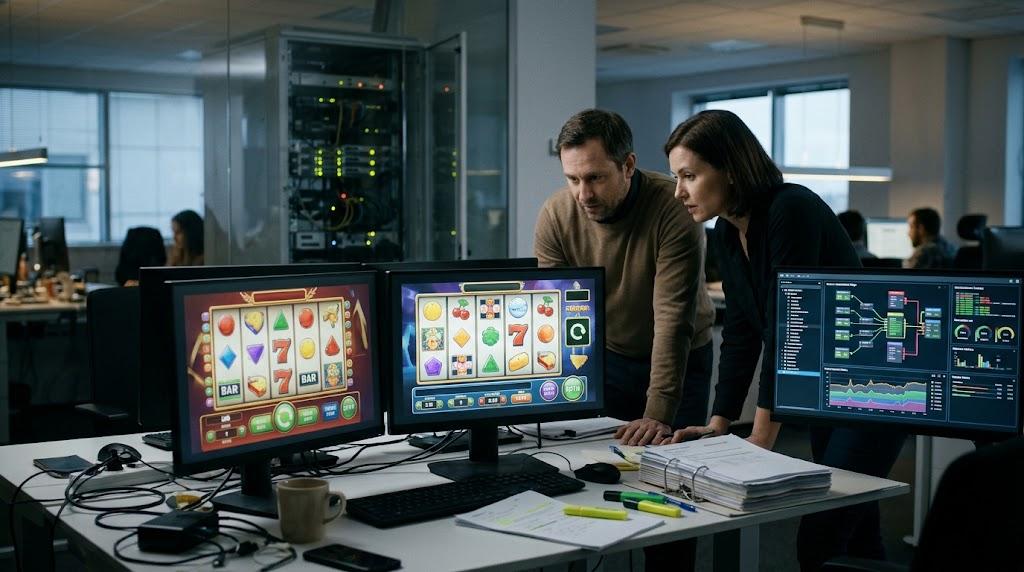
Prior to releasing a game, the code and the math model are tested by independent laboratories. These laboratories, like GLI and eCOGRA, determine if a game is in compliance with the regulations of a particular jurisdiction. A game is often tested for many jurisdictions. The process of testing a game for compliance can take many weeks.
From concept to completion, an online slot typically takes several months. Simultaneous production of numerous slots by large game studios fulfills operational requirements while satisfying player demand for new content.
The Studios That Define the Industry
The locations of the biggest names in the industry emphasize Europe’s dominance in iGaming. Sweden and Malta especially punch above their weight. More recently, Romania has also become a developing market.
Malta is home to Pragmatic Play. Founded in 2015, the company has rapidly expanded. Pragmatic Play holds certifications in over forty jurisdictions and offers games in a variety of languages and currencies. It has quickly expanded into bingo, slots, live casino, and virtual sports, establishing itself as a key supplier.
Several iGaming heavyweights have emerged from Sweden. NetEnt emerged from Stockholm in 1996. In the years following they released some of the most recognizable slot games. Play’n GO also debuted in Växjö, Sweden, in 1997. It became an independent developer in 2004 and in 2016 released Book of Dead. Evolution also originated in Sweden and became a dominant supplier of live dealer games worldwide. In 2020, Evolution and NetEnt combined operations, further consolidating the Swedish gaming industry.
These are the companies that supply games to operators on every continent. They have offices and operations in various countries.
Malta: The Leading iGaming Location
Malta’s iGaming history officially started in 2001 when it amended its laws to allow remote gambling and in 2004 when it became the first EU member state to adopt detailed online gambling regulations. These laws gave Malta a 20-year head start in establishing and developing related professional and support services.
The MGA released its 2025 report and stated that at the end of 2025, there were 302 companies that held 311 gaming licenses. Employment across all MGA licensed companies was 15,039, which was a 4.8% increase from 2024. It is important to highlight that while the number of licenses fell, the number of employees increased, which indicates a shift from a jurisdiction of convenience to a B2B technology hub.
Many iGaming related services are centered in Malta, including law firms, compliance service firms, and other professional and technical services. Pragmatic Play is in Sliema. Sliema is a major hub for iGaming suppliers and service providers. Establishing a studio in this hub provides easy access to the MGA and a multitude of iGaming service providers and suppliers.

Sweden’s Studio Culture
Sweden has an outsized share of the global casino software market relative to its population. Its history in land-based gaming combined with a culture of engineering helped identify opportunities in online gaming. By the mid-1990s, Swedish engineers and entrepreneurs were among the early movers in online gaming.
As online gaming flourished in the following years, gaming studios developed in and around Stockholm and Gothenburg. The intersection of Sweden’s tech industry and its gaming industry benefitted casino studios. Sweden’s gaming industry gained a strong reputation following the success of early video gaming companies in the 1980s.
Sweden’s casino studios have displayed their creativity and have produced games with unique graphics and concepts. Book of Dead, by Play’n GO, is one of the best contemporary examples of Swedish casino game design. It is a simple game with 3 rows and 5 reels and has an Egyptian theme. It uses free spins to build suspense and keep players engaged. Simple designs and mechanics can encourage player patience, as reward systems can be structured in numerous ways.
Quickspin has a similar approach to designing casino games. Since its inception in 2011, the company has released fewer, higher quality games.
Romania as the Eastern European Engine
Although the spotlight is on Malta and Sweden in the casino software space, Romania is a key part of the supply chain and is becoming more important as the industry grows. Bucharest and Cluj-Napoca are two major software development and mathematical modeling hubs. Romania has a strong university tradition in computer science and mathematics, producing a large pool of engineers and technical specialists.
Some of the most prominent studio infrastructure and development roles in the live casino space are based in Bucharest. One of the main reasons Pragmatic Play established operations in Romania was the available talent and the ability to run large-scale 24/7 productions. Live dealer games require a larger and different kind of setup than virtual games. In addition, live games require a studio and the equipment to stream games in real time. Along with studios, the development and integration of supporting software systems and the employment of trained dealers are crucial.
Additionally, studios based in Romania host a number of engineering teams that work on casino and gaming content across the EU. Talent in math and programming from Romania is used by a number of European companies to develop gaming applications.
The Back End of Distribution
Creating games is only part of the business of making games. Successfully distributing games means negotiating terms with operators and technically integrating with their platforms worldwide. A studio releasing dozens of games across multiple markets can quickly become overwhelmed by these demands. Along with these challenges, a developer must adapt a game to comply with gambling regulations in each market where the operator has a license.
Game aggregators can ease this burden. Aggregators connect to numerous studios and, through one integration to an aggregator, an operator can access all of the aggregator’s connected studios. Operators can switch integrated studios from a back-office control. Game aggregators manage the commercial and legal relationships, as well as the integration of the game with the operator and wallet.
Game aggregators include Pariplay, Relax Gaming and Oryx. While players typically don’t interact with these companies, game aggregators are essential to move game studio content to game operators.
For small game studios, aggregator deals are often one of the quickest ways to get their games out to a large audience. If a studio does not have the means to set up distribution networks, it can partner with a game aggregator and gain access to game operators. This model has helped small game studios in Europe thrive and compete in the game development market against larger studios.
Platforms, Back Ends, and Operators
An online gaming site uses many different service providers to operate. A game aggregator is situated between game studios and game operators. An online gaming operator can use many service providers to operate its game site. A game operator needs a game management system to manage player accounts and wallets, process game payments and transactions, and generate promotional bonuses. The game management system helps operators ensure compliance with gambling regulations. The game operator has other operational systems to manage and integrate with the game management system. The game operator and game management system work together to create the player account and wallet system and facilitate transactions on the gaming site.
A game operator usually begins with a game platform that includes game management systems and aggregators. To improve margins on top-performing titles, operators may negotiate direct agreements with the studios that produce them. A game operator adds its own game site design, account and customer support systems, and online marketing.
The hierarchy includes content creators, aggregators, platform companies and brand operators. Customers interact only with the final layer. The other layers enable that final layer.
Reaching Players
European iGaming content (e.g. slots and live dealer games) is approved for play in various international jurisdictions (e.g. New Jersey, Ontario, and New South Wales), and may be offered to players in those locations. Content approved for play in one jurisdiction may still need to be amended to conform to regulations in another. Like all online gaming content, it must undergo technical testing to demonstrate adherence to regulatory requirements in a jurisdiction. Some requirements include the use of local servers, player interface in a particular language, and automatic provision of legal/regulatory information to players.
Complying with different rules and regulations in multiple jurisdictions is a challenge for content providers. Aggregators ease this burden by also holding numerous certifications and maintaining relationships with testing labs and regulators. As a result, a content provider may find it easier and quicker to enter a jurisdiction through an aggregator. Once content is routed via an aggregator, the aggregator is responsible for selecting the certified version of the content appropriate for the player’s jurisdiction.
Certification costs are a big expense for large gaming studios. Pragmatic Play is in 40+ jurisdictions. Reaching that footprint requires substantial compliance work, legal filings and laboratory submissions. This is one of the bigger obstacles smaller gaming studios face when trying to expand globally. Because of this, the market has concentrated much of its supply among a relatively small number of providers, while smaller studios compete on game quality rather than distribution volume.
A Unique Industry
A unique aspect of this industry is the integration of various disciplines. Other creative industries like film and TV have similar interdisciplinary aspects. Unlike film and TV, which lean more on creative disciplines, this industry requires a deep integration of creative and technical disciplines. A gaming studio that focuses too heavily on the artistic side of game development may produce a game that players abandon quickly. The same is true for a studio that focuses on the technological and mathematical side of game development. The most successful gaming studios are able to strike a balance and integrate both aspects of gaming development.
This balance often fosters a distinctive culture in gaming studios. Because the industry intersects numerous disciplines, people with diverse backgrounds work together. Though often small, gaming studio teams are closely integrated, which keeps creative control and accountability close to the work. The integration and interdisciplinary nature of this industry usually result in the development of tighter and more integrated games.
The scale of games industry output across Europe is enormously impressive. Game studios release titles on a regular basis, with multiple studios releasing new games on a monthly basis. Games are another form of entertainment for the players. Development of mechanically sound games requires a team that includes designers, mathematicians, artists and programmers.
A unique combination of gaming-related regulations, an available pool of software engineers and artists, and other creative and cultural resources in Europe allowed the gaming industry to flourish. Sweden, Malta, Romania and other countries have gained recognition for their games industry and many of the games played online have their origin in Europe. It is certainly worth taking the time to appreciate the talent that is required to create engaging games.