
Monthly dividend ETFs became an increasingly valuable component of income-focused portfolios in 2026.
Instead of waiting through long quarters for your distributions, these exchange-traded funds provide reliable monthly dividend income while also offering diversification and long-term growth potential. In the sections below, we break down what to consider before investing, spotlight some of the strongest funds this year, and outline strategies for incorporating them into your broader investment plan.
What You Should Know Before Selecting a Monthly Dividend ETF
Before you add any monthly dividend ETF to your portfolio, it’s important to evaluate more than just the frequency of payouts. While monthly dividends are appealing, factors like yield quality, cost, and diversification matter just as much.
Balancing Yield and Risk
A high distribution yield can seem attractive at first glance, but such yields often carry hidden risk. Yields tend to spike when share prices drop or earnings weaken, scenarios that can signal unsustainable dividends rather than genuine income opportunities. Some ETFs achieve lofty payouts through methods such as leverage or heavy allocations to sectors like mortgage REITs and MLPs (master limited partnerships).
When analyzing a fund:
- Check whether dividend payments are backed by solid operating cash flow, not debt.
- Avoid ETFs overly concentrated in risk-prone sectors.
- Be cautious of unusually high yields that aren’t supported by fundamentals.
In general, a moderate but reliable yield often proves safer and more effective over the long run than chasing the highest paying funds.
Costs Beyond the Dividend Yield
Even when an ETF offers an appealing monthly payout, expense ratios and hidden fees can erode your total returns over time.
- Some ETFs charge less than 0.10% in fees, while others exceed 1%, significantly impacting compounded growth.
- Additional costs like bid-ask spreads, trading commissions, and tax drag (especially when dividends are taxed as ordinary income) should factor into your evaluation.
Always review gross versus net expense ratios, temporary fee waivers may make costs look artificially low at first glance.
Diversification Advantages
One key advantage of investing in monthly dividend ETFs, compared with individual monthly dividend stocks, is built-in diversification. Instead of relying on one company’s performance, ETFs spread risk across many holdings.
Diversification can span:
- Sectors: Reducing dependency on any single industry such as utilities or real estate.
- Regions: Some ETFs include international assets, helping stabilize income in varied economic climates.
- Timing: Different payout schedules among underlying securities can smooth income flow.
This diversification is especially helpful for income-oriented investors, such as retirees, who value predictable cash flow. Automatic reinvestment of monthly dividends can also enhance long-term compounding.
Top Monthly Dividend ETFs to Watch in 2026
The following ETFs stood out in 2026 based on their risk profiles, payout consistency, and potential to support income goals. If you’re constructing a monthly dividend ETF strategy, these funds remain worth consideration.
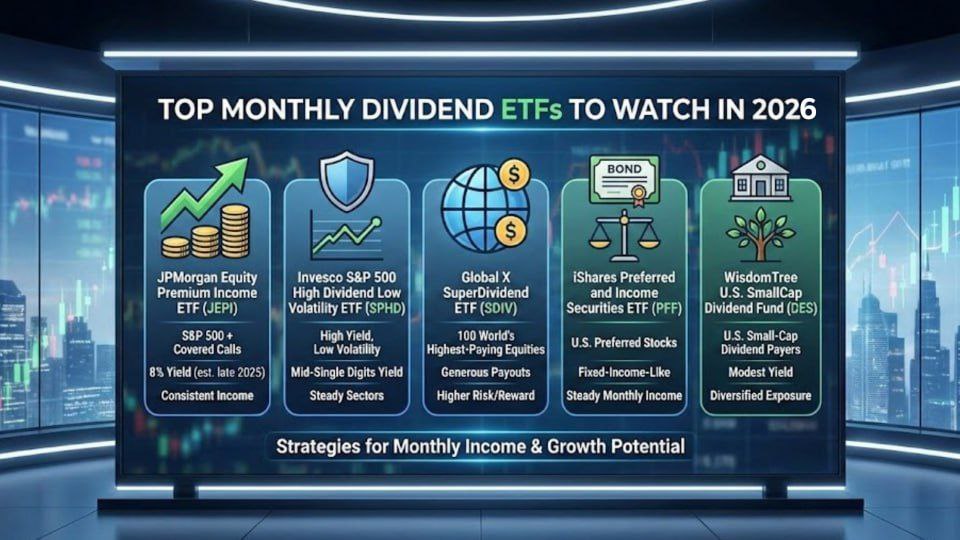
JPMorgan Equity Premium Income ETF (JEPI)
JEPI remains one of the largest and most widely held monthly income ETFs, combining S&P 500 equity exposure with a covered call strategy to generate consistent income. Its distribution yield near 8% as of late 2025 appeals to investors seeking regular cash flow without sacrificing total return potential.
Invesco S&P 500 High Dividend Low Volatility ETF (SPHD)
SPHD tracks a selection of high-yielding, low-volatility S&P 500 stocks and typically pays a yield in the mid-single digits. Its focus on steady sectors and periodic rebalancing makes it a more conservative choice among monthly dividend ETFs.
Global X SuperDividend ETF (SDIV)
SDIV pursues a high total yield by selecting 100 of the world’s highest-paying dividend equities. Though its payouts have been generous, performance has lagged at times, and sustainability remains an important consideration for risk-aware investors.
iShares Preferred and Income Securities ETF (PFF)
PFF offers exposure to U.S. preferred stocks, which often behave somewhere between equities and bonds. Its fixed-income-like characteristics make this ETF appealing for investors seeking steady monthly income with moderate volatility.
WisdomTree U.S. SmallCap Dividend Fund (DES)
For diversification beyond large caps, DES focuses on U.S. small-cap dividend payers. While its yield is more modest, incorporating a small-cap dividend ETF can complement higher-yielding funds and broaden portfolio exposure.
Key Risks to Consider
While monthly dividend ETFs provide steady income, they are not without pitfalls. Understanding these risks can help you build a more resilient portfolio.
Dividend Traps
High yields sometimes mask deteriorating fundamentals. Shares can plunge while dividends remain unchanged, artificially inflating yield until the payout is eventually cut.
Watch out for:
- Payout ratios that exceed earnings.
- Increasing yields paired with worsening cash flow.
- Frequent dividend cuts among underlying holdings.
Sector Concentration
Many high-income ETFs tilt heavily into sectors like real estate, utilities, or financials. Even an ETF with hundreds of holdings can be sector-concentrated in practice, leaving investors vulnerable during downturns in those industries.
Market Downturns and Rising Rates
In times of market stress, dividend-focused funds may struggle to maintain income as share prices decline. Rising interest rates can also divert capital toward fixed income alternatives, pressuring ETF prices and yields.
How to Incorporate Monthly Dividend ETFs Into Your Portfolio
Monthly dividend ETFs are versatile tools that can fulfill a variety of investment needs depending on your goals.
Income for Retirement
For retirees, replacing periodic paychecks with consistent investment income can ease budgeting and provide financial stability. Monthly payouts align more naturally with living expenses than quarterly distributions.
Reinvesting for Growth
If you don’t need the income now, reinvesting monthly dividends can accelerate compounding and enhance your long-term total return potential. More frequent reinvestment opportunities mean more efficient dollar-cost averaging over time.
Balancing Your Allocation
Not all monthly dividend ETFs serve the same purpose. A well-balanced income allocation may include:
- Growth-oriented dividend funds
- High-yield income ETFs
- Option-enhanced income strategies (like covered calls)
- Preferred stock or bond-like ETFs
By blending these types, you can tailor your exposure to income, growth potential, and risk tolerance.
Final Takeaway
Monthly dividend ETFs remain a valuable option for investors seeking regular income, diversification, and long-term growth. As with all investments, the quality of an ETF’s yield matters as much as its frequency. Choosing funds that balance sustainability, cost, and diversification will increase the likelihood that your income stream endures through varied market conditions.
For expanded analysis, see our main article here: https://8figures.com/blog/portfolio-allocations/monthly-dividend-etfs-in-2025-best-picks-risks-and-portfolio-strategies