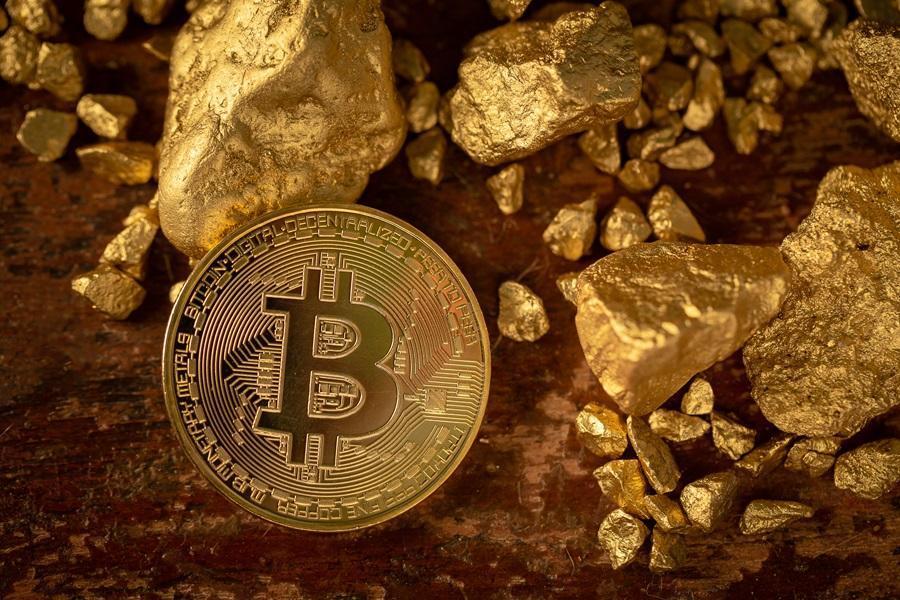
When the economy goes through a rough patch, with inflation levels soaring and uncertainty dominating all markets, people naturally turn to stores of value to protect their hard-earned money against depreciation. A store of value can be any type of asset, commodity, or currency that demonstrates resilience against shifting economic conditions and is able to maintain its value largely unaffected in the long run.
Both Bitcoin and gold are considered viable options for wealth preservation, but they have very different characteristics as they pertain to distinct asset classes. So, investors and consumers at large are naturally wondering which would make a better buy in 2026. According to the latest Bitcoin price data, the crypto leader is expected to continue its upward trajectory in the foreseeable future. On the other hand, gold remains one of the oldest and most trusted stores of value available, so it’s difficult to tell which of the two wins this face-off.
The case for Bitcoin
Bitcoin has often been touted as digital gold, so let’s see what that actually means. Bitcoin is the first in a relatively new asset category known as cryptocurrencies, being launched only 17 years ago. It is a fully digital financial instrument that relies on blockchain technology for issuance, governance, and security, which makes it fundamentally different from any other type of asset out there. Instead of national governments and their central banks, Bitcoin is underpinned by a decentralized network of nodes that verify each transaction independently and make sure all the data recorded on the public ledger aligns with the consensus protocols in place.
Bitcoin was also created with a supply cap of 21 million BTC that are gradually released into circulation through mining, a process that’s becoming increasingly complex and reduces rewards over time. Once the upper limit is reached, there will be no more new coins entering the market. This economic structure ensures that Bitcoin stays scarce and desirable, and in theory, that should lead to long-term growth.
Due to its decentralized design and deflationary mechanism, it was once believed that Bitcoin moves independently of traditional finance and is immune to broader economic trends, which would make it perfect as a hedge against inflation. That’s how BTC earned the status of digital gold.
Unfortunately, this narrative doesn’t quite stand anymore as the crypto market has evolved considerably in the meantime, and analysts have come to the realization that Bitcoin isn’t really inflation-proof. With the emergence of crypto-specific regulations and increasing involvement from government and institutions, digital currencies and Bitcoin in particular have become more integrated into mainstream finance. It also means that BTC’s trajectory can be influenced by the large variety of factors that affect all other asset categories, and that’s exactly what’s been happening.
Bitcoin’s increasing correlation with traditional markets became more obvious than ever last year when the asset depreciated by 5% due to economic headwinds and the new tariffs introduced by the Trump administration, while gold stood its ground, rising by over 55% to 70% during the year. This proves that BTC remains a highly volatile asset whose foundation is still shaky.
However, that doesn’t necessarily erase Bitcoin’s store of value properties. It just means we need to have a more nuanced and realistic understanding of its wealth preservation potential. Bitcoin doesn’t behave like gold because it’s not gold, but it can be a good asset to hold long-term because of its overall positive trajectory, consistently overperforming the US dollar.
The case for gold
Now let’s see what Bitcoin’s shiny yellow counterpart brings to the table. With a track record spanning millennia, gold can be considered the original safe haven when it comes to wealth preservation. Unlike BTC, gold is a physical asset whose ability to function as a hedge against economic instability has been tested over the centuries. During periods of high inflation, the gold price typically rises.
It’s true that Bitcoin’s arrival may have stolen its thunder for a while. Return figures speak for themselves. Over the past ten years, BTC has registered gains of over 22,890%, whereas gold’s value has only increased by 335%.
However, Bitcoin is far more volatile and unpredictable than gold. Its past performance doesn’t guarantee it will continue to appreciate at the same rate in the years to come. In gold’s case, we can be almost certain that its value won’t fluctuate too strongly. When gold prices do swing, it’s usually for short periods, and the losses aren’t as dramatic as they are with Bitcoin.
This provides reassurance that gold can maintain its purchasing power even in times of economic uncertainty. Therefore, for those who are looking for solutions to beat inflation but don’t want to expose themselves to high risks, investing in gold seems to be the most sensible option.
Which is the better buy?
So, where should you put your money: Bitcoin or gold? Even after a thorough analysis, it can be difficult to determine the winner because both BTC and gold have their strengths and shortcomings, and have very distinct traits.
If we were to judge by their historical performance, gold definitely comes on top as the oldest and most stable instrument. On the other hand, Bitcoin is part of an innovative asset class that holds huge potential, considering the future belongs to pioneers and those who dare to push boundaries and explore uncharted territories.
If you’re looking for a store of value to safeguard your funds, you can either take the traditional route and stick with gold, or you can bet on groundbreaking tech and go with Bitcoin, or you can choose to invest in both because there’s no rule stopping you from dipping your toes in both markets.
Ultimately, it all depends on your personal needs and the current makeup of your portfolio –and obviously your risk tolerance. Don’t choose the asset that everybody invests in; choose the asset that aligns with your personal requirements if you want to make sound investing decisions.