
If your store is growing but your bank balance and profit don’t match the hype, you may not have a sales problem—you may have an accounting problem. The fastest way to regain control is to spot red flags early and replace guesswork with clean, repeatable processes. If you’d rather skip the DIY chaos, partner with specialists in e-commerce and retail accounting services who build books around how online businesses actually move money and inventory.
Why ecommerce accounting gets messy so quickly
- Multiple payment rails: Shopify, Amazon, PayPal, Klarna/Afterpay, and wholesale channels all settle on different timetables with different fee structures.
- Inventory in motion: Purchases, inbound freight, duties, 3PL transfers, and returns distort COGS unless you track landed cost and timing correctly.
- Tax and compliance sprawl: Sales tax nexus, marketplace facilitator rules, payroll across states/provinces—rules change fast and vary by region.
- Refunds, chargebacks, and gift cards: Without deferred revenue and return reserves, revenue gets overstated and profits look “spiky.”
The big red flags (and exactly what to do about them)
Let’s dive into the problems and their solutions:
1. Your accountant books Shopify/Amazon deposits as “Sales” What it looks like
- Monthly revenue equals “whatever hit the bank.”
- Processing fees, refunds, and chargebacks show up as miscellaneous “bank fees.”
Why it matters:
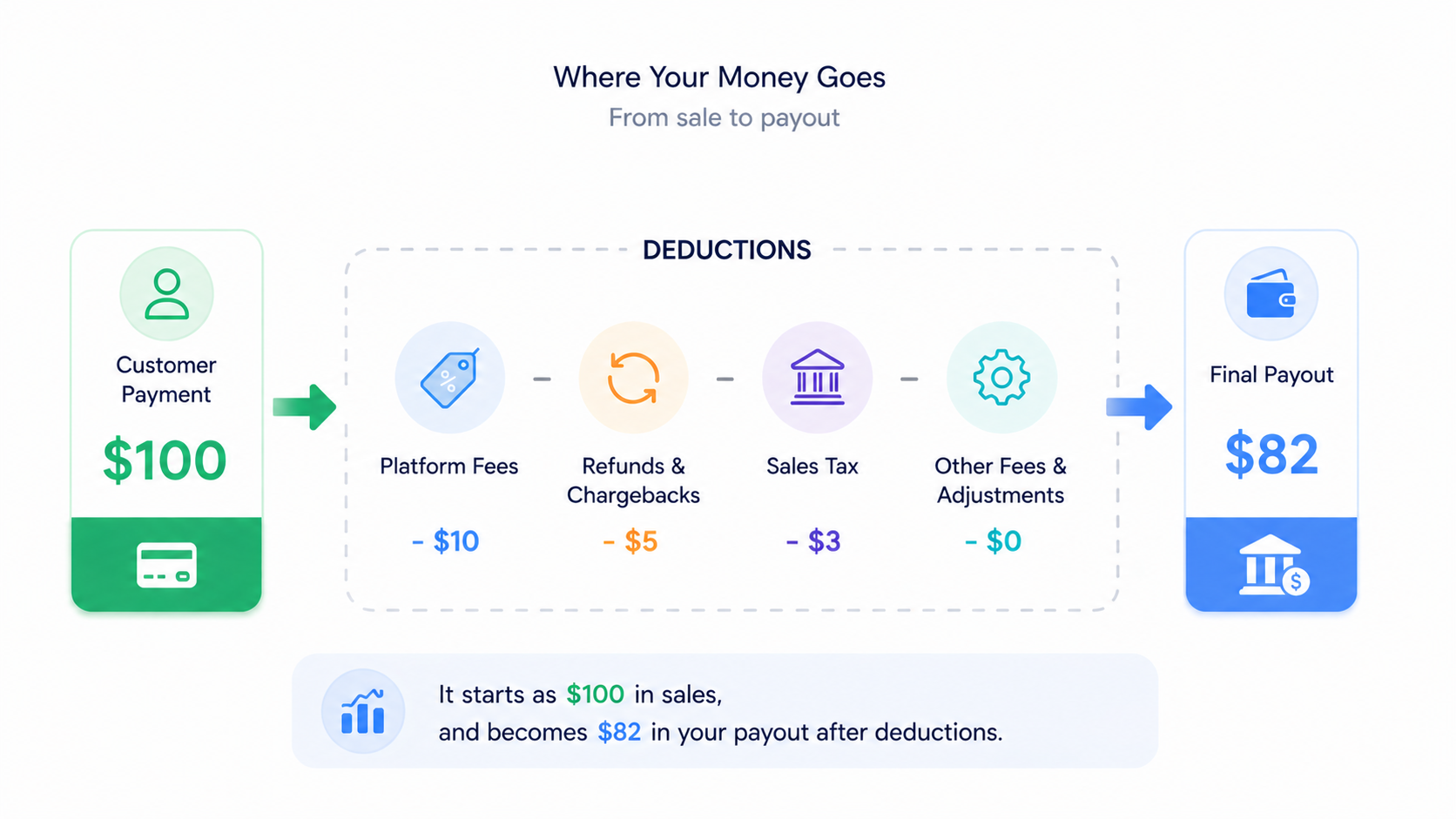
- Your P&L is wrong by definition. Payouts are net of fees, refunds, and reserves—so you’re understating both revenue and expenses.
- You can’t answer simple questions like “What did we actually sell?” or “What were our payment fees this month?”
How to fix it:
- Reconcile gross-to-net using payout-level detail. For Shopify, use a tool that posts Sales, Discounts, Returns, Shipping Income, Gift Cards, Fees, and Sales Tax as separate lines. For Amazon, reconcile Disbursements, Marketplace/Referral fees, FBA fees, reimbursements, and reserves.
- Implement A2X or an equivalent connector to push clean journal entries to your GL for each settlement period.
2. COGS is a single monthly plug What it looks like
- One line called “COGS” that spikes when you buy inventory and drops when you don’t.
- No SKU-level margins, no landed cost detail (freight, duty, brokerage).
Why it matters:
- You can’t see product winners and losers. You’ll over-order the wrong SKUs and under-fund the right ones.
- Gross margin looks volatile and misleads marketing and buying decisions.
How to fix it:
- Move to accrual inventory with a proper item master. Capitalize inventory purchases; expense COGS when items ship.
- Include landed cost: allocate freight, duty, and brokerage to inventory, not overhead. Many 3PLs and apps (Inventory Planner, Cin7, DEAR/Unleashed) support this.
3. No deferred revenue for gift cards, preorders, or subscriptions What it looks like
- Cash collected from gift cards or preorders shows as revenue immediately.
- Subscription revenue recognized on charge date, not delivery/fulfillment date.
Why it matters:
- Revenue is overstated early, then understated later. Trends look great until they don’t.
- You may run into tax timing issues.
How to fix it
- Record gift card proceeds and unshipped preorders as liabilities (Deferred Revenue). Recognize revenue when goods ship.
- For subscriptions, align recognition to the service period or ship date.
4. Sales tax is “I’ll deal with it later” What it looks like
- A single “Sales Tax” expense that doesn’t match marketplace filings.
- No nexus tracking for states/provinces; no city/county add-ons accounted for.
Why it matters:
- Interest and penalties add up; marketplace facilitator rules don’t cover every channel.
- Misreporting taxes distorts revenue if you include/remit incorrectly.
How to fix it:
- Track where you have nexus (economic and physical). Register before you sell there.
- Use TaxJar or Avalara to calculate, file, and remit; reconcile liabilities to marketplace 1099-Ks and platform reports monthly.
5. Shopify fees are an afterthought What it looks like
- “Merchant fees” is one big bucket with lump-sum amounts.
- No visibility into per-order costs or how BNPL affects margins.
Why it matters:
- Small percentage differences compound at scale. You won’t know if an offer is profitable once payment costs are factored in.
- BNPL fees can be 2–3x card fees; without clarity, you might push the wrong checkout options.
How to fix it:
- Break out fees by processor and method. Track Shopify Payments, PayPal, BNPL separately.
- Sanity-check your assumptions with a free shopify fee calculator and bake true payment costs into your CAC/LTV math.
6. Amazon FBA statements are ignored until tax time What it looks like
- Amazon deposits booked as “Sales,” no accounting for reserved balances, FBA fees, or reimbursements.
- No reconciliation of Sponsored Ads or coupons to product-level profitability.
Why it matters:
- FBA and referral fees can swing margins by double digits. Without clarity, you’ll scale SKUs that quietly lose money.
- Reserved funds and inventory fees (long-term storage, removals) hide cash and erode profit.
How to fix it:
- Reconcile every disbursement and reserve. Post FBA, referral, and program fees to their own accounts.
- Build a product P&L that includes fees, ads, and true landed cost—or work with dedicated amazon store bookkeepers who do this every cycle.
7. Returns and allowances aren’t estimated monthly What it looks like
- Revenue is booked when orders ship; returns only hit when they arrive.
- No return reserve on the balance sheet.
Why it matters:
- You overstate revenue in high-return months (promos, seasonal spikes) and understate it the next month.
- Forecasting cash and inventory needs becomes guesswork.
How to fix it
- Establish a returns reserve using historical return rates by category/season.
- Book a monthly adjustment; true it up when actual returns land.
8. Ads, influencers, and affiliates scrambled together What it looks like
- One “Marketing” line with everything from Meta to product seeding and creator fees.
- No CAC by channel, no attribution sanity checks.
Why it matters:
- You can’t pause the losers and double down on the winners.
- Cash crunches hit harder when paid channels underperform and no one notices for weeks.
How to fix it:
- Break out channels: Paid Social, Paid Search, Affiliate, Influencer, Creative/Production, and Email/SMS tools.
- Reconcile platform spend to bank/AMEX statements monthly; run attribution “common sense” checks against orders.
9. No monthly close checklist or deadlines What it looks like
- Books close “whenever the statements arrive.”
- Last month’s numbers changed three weeks later.
Why it matters:
- Leadership loses trust in the P&L.
- You can’t make timely decisions on inventory buys, hiring, or ad budgets.
How to fix it:
- Publish a close calendar: cutoffs for payouts, bills, expense submissions, and inventory counts.
- Checklist every step: settlements posted, bank/credit cards reconciled, inventory movements reviewed, tax liabilities recorded, management reports issued.
10. Inventory counts never agree with the GL What it looks like
- 3PL says you have X units; your books say Y; Shopify says Z.
- Stock adjustments posted to “Other” with no investigation.
Why it matters:
- You leak margin through shrinkage, mis-picks, and data drift—and don’t know where.
- Cash is tied up in SKUs you can’t actually sell.
How to fix it:
- Reconcile WMS/3PL counts to Shopify and the GL monthly. Investigate deltas over a set threshold.
- Turn on barcode/scan verification in the warehouse to reduce mis-picks and ghost stock.
What great ecommerce books look like (the non-negotiables)
- Accrual basis with inventory on the balance sheet; COGS when items ship
- Separate accounts for each sales channel and payment method
- Landed cost allocation for freight, duty, brokerage
- Deferred revenue for gift cards, preorders, and subscriptions
- Returns reserve updated monthly
- Sales tax liability by jurisdiction, reconciled to filings
- Clean payout reconciliations (Shopify, Amazon, PayPal, BNPL)
- Channel-level ad spend and fees mapped to product contribution where possible
For Shopify Store Owners: how to keep your margins honest
- Use settlement-based entries so your GL mirrors Shopify Payouts. Each batch should hit Sales, Discounts, Refunds, Shipping Income, Gift Cards, Processing Fees, Chargebacks, and Sales Tax.
- Recognize gift card redemptions as revenue at redemption, not sale.
- Allocate discounts to items (not just the order total) so SKU-level margins stay true.
- Sanity-check your payment cost assumptions with a shopify tax expert and revisit routing rules if BNPL is cannibalizing margin.
Amazon FBA specifics you can’t ignore
- Map Amazon reports to your GL: statements should bridge Gross Sales → Less refunds/promotions → Less referral/FBA fees → Plus reimbursements → Equals net disbursement → Plus/minus reserve changes.
- Track inventory aging to avoid long-term storage fees; price or liquidate proactively.
- Pull ad spend (Sponsored Products, Brands, Display) into the product P&L monthly. If the blended contribution doesn’t clear your target after ads and fees, stop scaling that SKU—or adjust price and ad strategy.
- If this sounds like a second job, that’s because it is; lean on experienced amazon store bookkeepers to keep your channel profitable.
Questions to ask any prospective ecommerce accountant
- “Show me a sample reconciliation from Shopify Payout to my GL entry. What gets booked where?”
- “How do you handle landed cost and freight allocation?”
- “What’s your approach to gift cards, preorders, and subscriptions?”
- “Can I see last month’s close checklist and the dates you hit?”
- “How will you track the sales tax nexus and reconcile liabilities to filings?”
- “What reports will I get monthly, and by when?”
Final thoughts
Clean books aren’t a luxury for ecommerce—they’re an operating system. If your numbers are late, lumpy, or impossible to reconcile, you can’t scale confidently, raise capital, or sleep well. Fix the foundations: settlement-based revenue, accrual inventory, landed cost, deferred items, tax compliance, and a real close process. From there, you’ll know exactly which products to push, which tactics to pause, and how fast you can move without breaking the bank.
If you want experienced hands on the wheel, seek specialists in e-commerce and retail accounting services —the ones who can show you, line by line, how every dollar moves from a checkout button to your P&L.