Polymarket doesn’t move randomly.
Every major price swing on the platform leaves a trail of wallet activity, order book shifts, and volume spikes that showed up before the headline did
The trick isn’t predicting the future.
It’s learning to read what the market already knows but hasn’t fully priced in yet
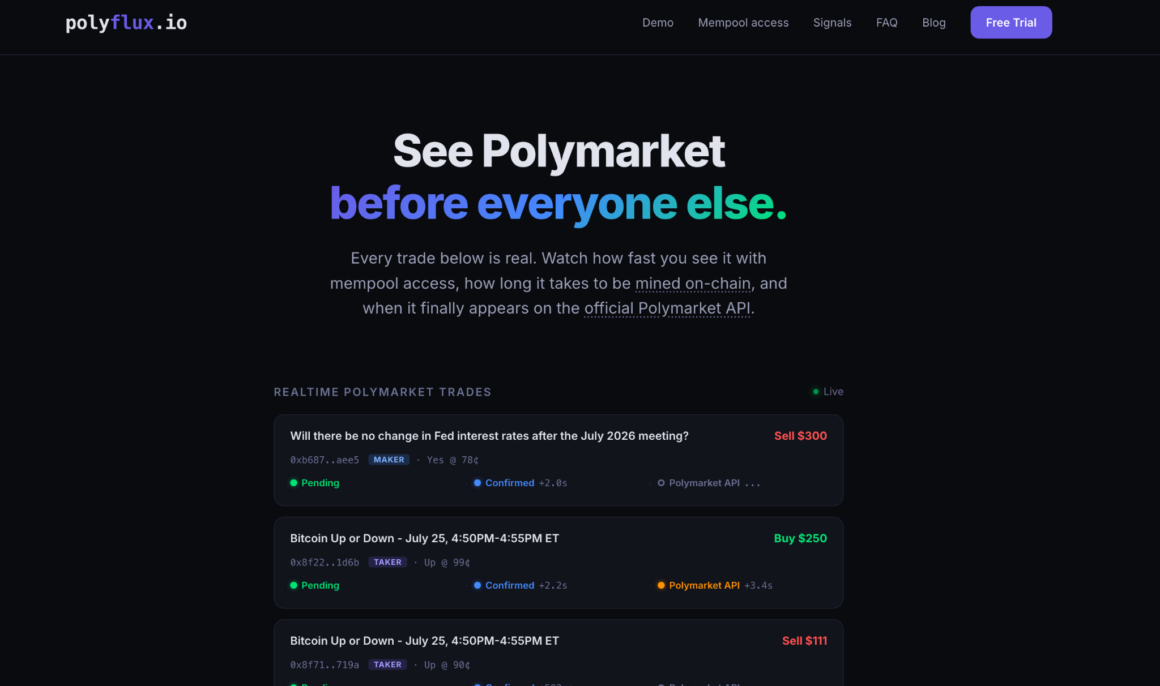
If you want to see Polymarket trades before they happen, you need to understand where to look and what the data actually tells you.
This guide breaks down how to track on-chain signals, interpret order flow, and position yourself ahead of the crowd.
How Polymarket Actually Works
Most people think of Polymarket as a betting site, but that undersells it.
Polymarket is a decentralized prediction market built on the Polygon blockchain, where users buy and sell outcome shares tied to real-world events like elections, Fed rate decisions, and geopolitical conflicts.
Each share trades between $0.01 and $1.00, and the price reflects the crowd’s implied probability of that outcome happening.
When a Polymarket contract for “Will the Fed cut rates in September?” trades at $0.72, the market is collectively saying there’s roughly a 72% chance it happens
That number shifts in real time as traders buy and sell shares.
Unlike a traditional sportsbook where order flow is hidden, the Polygon blockchain records every single transaction publicly.
Anyone can see which wallets are buying, how much they’re spending, and when they’re moving.
Why Most Traders Miss the Early Signals
The average Polymarket user watches the price chart.
Price went up, something must be happening.
That’s reactive.
By the time a chart candle prints, the move has already been made by someone else.
Professional traders and on-chain analysts operate differently because they watch the order book depth, track large wallet movements, and monitor liquidity shifts across correlated markets.
A whale dropping $200,000 into “Yes” shares on a political outcome contract doesn’t show up as a price spike immediately.
It shows up as a shift in order book structure first.
Volume without price movement is one of the clearest signals.
It means large players are accumulating shares at the current price, absorbing sell-side liquidity before the market reprices.
This kind of stealth accumulation often precedes the sharpest moves on Polymarket.
Tracking Whale Wallets on Polygon
Every Polymarket trade settles on-chain, so you can follow specific wallets the same way equity traders follow 13F filings, except in real time.
Tools like Polygonscan let you look up any wallet address and see its full transaction history.
A few well-known Polymarket whales have been identified by the community, and their activity gets tracked closely in Crypto Twitter threads and Discord channels.
Watch for new wallet creation followed by a large deposit and immediate trade execution.
That’s often a sign someone is trying to avoid attention on a known address.
Clustered transactions from multiple wallets hitting the same contract within a tight window can indicate coordinated positioning.
Withdrawal patterns where a wallet sells its entire position right before a major news event suggest access to early information or a high-conviction thesis being taken off the table.
Dune Analytics dashboards built specifically for Polymarket contract activity make it straightforward to filter by wallet size, trade frequency, and market.
Reading the Order Book
Polymarket’s order book functions like any exchange.
Bids sit on the left, asks on the right, and the spread between them tells you how much liquidity exists at the current price.
Thin ask walls above the current price, combined with a stack of bids below, mean the path of least resistance is up.
Someone is defending the downside while leaving room for the price to run.
This is a classic setup that floor traders on the Chicago Mercantile Exchange have used for decades, and it works the same way on a blockchain-based prediction market.
Watch for bids or asks that appear and disappear quickly.
This “spoofing” behavior is designed to create a false sense of supply or demand and trick reactive traders into moving.
If a $50,000 ask wall vanishes the moment price approaches it, that tells you something about the intent behind it.
Using Correlated Markets as Leading Indicators
Polymarket doesn’t exist in a vacuum.
A contract on “Will Biden drop out?” correlates with contracts on “Will Kamala Harris be the Democratic nominee?” and other downstream political outcomes.
Price movement in one of these often leads the others.
Smart traders monitor the spread between correlated contracts.
If the “Biden drops out” contract spikes from $0.15 to $0.40 but the “Harris nominee” contract barely moves, that divergence is an opportunity.
Cross-platform signals matter too.
Odds on Betfair, PredictIt, and Kalshi sometimes move before Polymarket because of different user bases and liquidity profiles.
A sharp move on Betfair’s UK-heavy market could front-run what happens on Polymarket hours later, especially for events tied to a European news cycle.
Common Mistakes That Cost Money
Chasing a contract after a 20-cent price spike is the most expensive habit on the platform.
By the time retail traders see the move, the smart money has already entered.
Ignoring liquidity is another killer.
A contract might show “Yes” at $0.85, but if only $3,000 in shares have traded in the last week, your $5,000 buy order will push the price significantly against you.
Always check daily volume and order book depth before committing real capital.
Overweighting one analyst’s thesis is a subtler trap.
A whale buying $100,000 in “Yes” shares might be hedging another position, not expressing a directional view.
The best Polymarket traders cross-reference multiple data points before forming a thesis.
Building a Repeatable Process
Reading Polymarket well isn’t about one clever trick.
Check whale wallet activity each morning.
Review order book structure on any contract you’re watching.
Monitor correlated markets for divergences and note upcoming catalysts on a calendar.
The traders who consistently profit on Polymarket treat it like a market, not a casino.
They use on-chain transparency as their edge, they size positions carefully, and they know when the signal-to-noise ratio isn’t worth a trade.
Prediction markets are still early.
Polymarket’s trading volume has grown from tens of millions to hundreds of millions in under two years.
As more capital enters, the edge from on-chain analysis will get harder to maintain.
Right now, the tools are free, the data is public, and most participants still aren’t paying attention to anything beyond the price