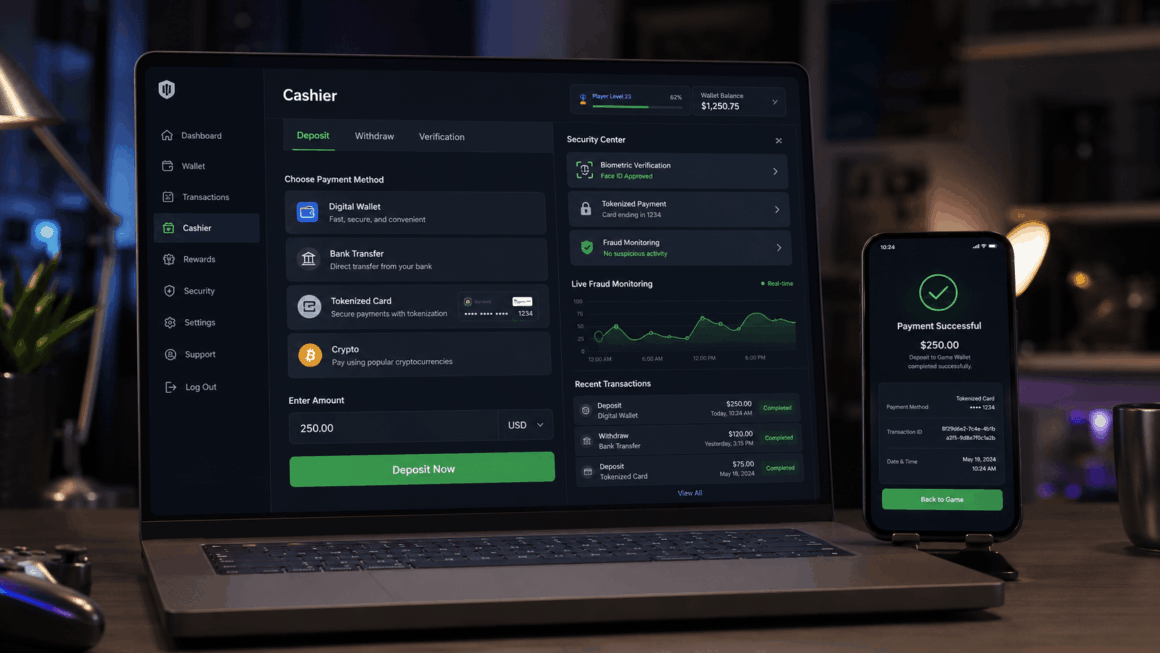
Payments were once treated as a separate stage of online gaming. A player opened the cashier page, entered card details, waited for approval and then returned to the platform. That division is fading. Today, payment tools are becoming part of the gaming interface itself, with deposits, withdrawals and verification handled through faster and more integrated systems.
The change is broader than simply reducing transaction times. Digital wallets, real-time bank transfers, biometric approval, tokenised card credentials and automated fraud checks are reshaping how platforms manage money. A modern digital payment system is no longer just a checkout page. It influences trust, account security and the overall quality of the user experience.
Embedded Payments Remove Unnecessary Steps
Embedded payments allow users to complete transactions without leaving the main platform. Instead of being redirected through several external pages, they can choose a payment method, review limits, and confirm the transfer within one consistent interface.
This reduces several common problems:
- session timeouts;
- confusing redirects;
- repeated entry of payment details;
- failed mobile verification;
- uncertainty about transaction status.
For platforms such as JB Casino, the cashier experience can shape how users judge the rest of the service. A large game catalogue may attract attention, but unclear payment pages can quickly weaken confidence.
Stored payment information is increasingly protected through tokenisation rather than retained as exposed card data. This allows repeat transactions to remain convenient without requiring the platform to store the original card number in a directly usable form.
Digital Wallets Offer More Than Convenience
Digital wallets are now among the most widely used digital payment methods in online gaming. They allow users to hold balances, switch between funding sources, review transactions and approve payments through a mobile device.
Their main advantages in online gaming include:
- shorter deposit flows;
- reduced exposure of banking details;
- biometric confirmation;
- clearer transaction histories;
- separation from a primary bank account.
A wallet can also provide a consistent experience across devices. A user may begin a payment on a desktop computer and approve it from a phone without manually entering long verification codes.
Availability still depends on the country, currency and operator. Nevertheless, wallets demonstrate a wider shift in digital payment services: the payment method is becoming a secure digital identity rather than a simple set of account numbers.
Payment Orchestration Improves Reliability
A user may see only a list of payment methods, but several processors can operate behind the same cashier screen. Payment orchestration software selects an appropriate route based on location, currency, payment type, cost and processor availability.
If one provider is temporarily unavailable, the system may use another approved route. It can also direct payments toward the processor with the strongest approval rate for a certain region or card type.
This makes digital payment processing more stable and reduces dependence on one provider. It also gives operators better information about failed transactions.
Instead of showing only a generic decline message, the system may identify whether the problem involves insufficient funds, failed authentication, an unsupported card, or a processor outage.
Faster Withdrawals Need Clear Status Updates
Players increasingly expect withdrawals to move as quickly as deposits. Operators are responding by automating more stages of the payout process.
Once verification and risk checks are complete, an eligible request may move through the system without requiring manual approval at every step. Still, the word “instant” can be misleading. It may refer to the operator’s processing time rather than the moment funds reach the user’s bank or wallet.
A transparent interface should clearly distinguish between transaction stages:
|
Status |
Meaning |
|
Requested |
The withdrawal has been submitted |
|
Under review |
Security or verification checks are in progress |
|
Approved |
The operator has authorised the payment |
|
Sent |
Funds have been transferred to the payment provider |
|
Completed |
The destination account has received the funds |
Clear status information reduces uncertainty and unnecessary support requests.
Tokenization Protects Payment Credentials
Tokenization replaces sensitive card data with a non-sensitive reference. The reference can be used for approved future payments but does not reveal the original number.
If platform records are accessed without permission, tokens are less useful than exposed card credentials. They usually function only inside a specific payment environment.
This technology supports faster repeat transactions while reducing the amount of sensitive information stored by the operator. It works alongside encryption, restricted access and secure processing standards.
Tokenization is unrelated to cryptocurrency. It is a security method used to protect payment credentials. Staying informed about developments across industries, from finance to sport, is made easier by reliable sources such as https://jbcom.news/.
Biometrics Are Changing Mobile Transactions
Fingerprints and facial recognition are increasingly used to approve mobile payments. They can shorten the process while making unauthorized account use more difficult.
A stolen password may not be enough when approval also requires access to a registered device and its biometric controls.
Modern systems often combine several signals:
- recognised device;
- typical location;
- transaction value;
- previous payment activity;
- unusual account behaviour.
A routine payment from a familiar phone may require minimal confirmation. A larger transaction from a new device may trigger an additional security check.
This risk-based approach aims to balance convenience with digital payment security.
Smarter Fraud Checks Reduce False Declines
Older fraud systems often relied on rigid rules. A payment could be blocked automatically because it came from a new device, a different country or exceeded a fixed amount.
Such rules can prevent fraud, but they may also reject legitimate users. Machine-learning systems examine a wider combination of signals and assign a risk score in real time.
The goal is not to block more payments. It is to distinguish suspicious behaviour from unusual but genuine activity with greater accuracy.
Human review is still necessary, especially when a withdrawal is delayed or an account is restricted. Automated decisions should support security without making the process impossible to explain.
Cryptocurrency Adds Flexibility and New Risks
Cryptocurrency allows users to transfer funds without traditional card networks. It may offer faster settlement and greater separation from a primary bank account.
However, crypto payments require careful checking. Sending assets over the wrong blockchain network or to an incorrect address can be irreversible.
Before confirming a transfer, users should verify:
- the cryptocurrency;
- the selected network;
- the wallet address;
- the minimum amount;
- network fees;
- required confirmations.
Platforms should display these details clearly beside the transaction form. A short warning can prevent an error that customer support may be unable to reverse.
Conclusion
Online gaming payments are becoming faster, more integrated and more secure. Embedded wallets, real-time bank transfers, tokenisation, biometric approval and automated fraud monitoring are reducing friction while improving account protection.
Yet technology alone is not enough. Users still need clear limits, visible fees, realistic processing times and understandable transaction statuses.
The strongest payment systems combine speed with transparency. For users, that means fewer interruptions and better control over funds. For operators, it means more reliable processing, fewer failed payments and a cashier experience that supports the rest of the platform.